


MAY 8 (part 2) - 4 Executions of Irish Republicans after Easter Rising 1916

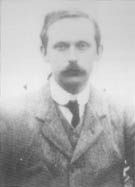
On this day 1916, Éamonn Ceantt, Michael Mallin, Seán, Heuston, and Con Colbert became the next 4 Irish republicans executed after the events of Easter Rising. All 4 were executed by firing squad at Kilmainham Gaol in Dublin.
Éamonn Ceannt (Edward Thomas Kent) was born 21 September 1881 in County Galway to James and Joanne (Galway) Kent. In 1899, Ceannt joined the central branch of the Gaelic League where he met many of the men who would play a major role in the Rising. He married Frances Mary O’Brennan in June 1905 and their son, Ronan was born in June 1906. During Easter Rising, Ceannt was commandant of the 4th Battalion of Irish volunteers and was stationed at the South Dublin Union. Despite holding out by the end of the week with as few as 20 men, Ceannt surrendered when the order was given and was subsequently arrested and court-martialed. On 7 May 1916, he wrote his last message from his cell at Kilmainham Gaol. “I leave for the guidance of other Irish Revolutionaries who may tread the path which I have trod this advice, never to treat with the enemy, never to surrender at his mercy, but to fight to a finish...Ireland has shown she is a nation. This generation can claim to have raised sons as brave as any that went before. And in the years to come Ireland will honour those who risked all for her honour at Easter 1916.”
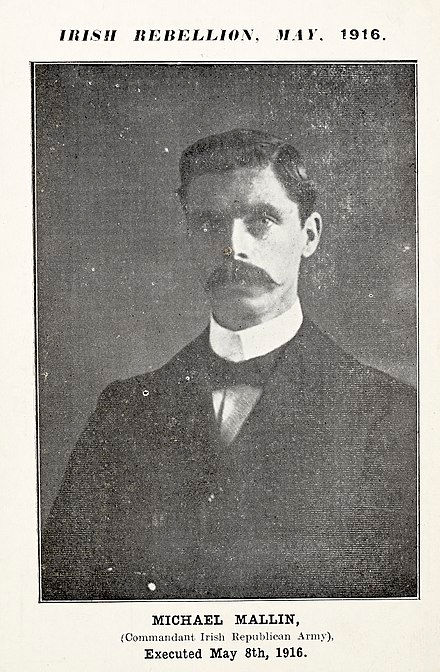
Michael Mallin was born 1 December 1874 in Dublin to John and Sarah Mallin. He was persuaded by an uncle to join the British army which he remained in for 14 years. It was during his time in India with the army that he became a staunch nationalist. Upon returning to Ireland after his military service he became a silk weaver and the Secretary of the Socialist Party of Ireland. He was appointed second-in-command and chief training officer of the Irish Citizen Army (ICA) and eventually was appointed chief of staff of the ICA in October 1914. In the early morning of Easter Monday 1916, Mallin took up a position at St Stephen’s Green with a small force of ICA men and women. After British troops were able occupy the nearby Shelbourne Hotel, Mallin ordered his troops to retreat to the Royal College of Surgeons on the west side of the park where they remained until the order of surrender reached them. His trial lasted less than 15 minutes and no members of the public or independent observers were allowed to witness.

Seán Heuston was born 21 February 1891 in Dublin. He worked as a railway clearn in Limerick and while there took an active parin in Fianna Éireann, where as an officer he arranged for members who could not afford to by their uniforms to do so by paying small weekly sums. In 1913, Heuston transferred to Dublin Fianna and went on to join the Irish Volunteers. He acted as the Director of Training for Fianna Éireann and served as Commander of the 5th company. During the Rising, Heuston was the commander officer of the Volunteers in the Mendicity Institution (Heuston’s Fort) on the south side of the city. His orders were to hold the position for 3 or 4 hours to give the HQ staff time to prepare their defenses. He went on to hold it for over 2 days with 26 Volunteers. After being surrounded and outnumbered he was forced to surrender. He was court-martialed on 4 May and had his death communicated to him on 7 May. He was executed the next morning.

Con Colbert was born 19 October 188 in County Limerick, Ireland to Michael and Honora Colbert. Colbert grew up as a deeply religious Catholic, and refrained from smoking or drinking. He was sworn into the IRB in 1908 and joined Fianna Éireann in 1909. In 1912, he became head of the IRB circle within the Fianna and in November 1913 he doing the newly formed Irish Volunteers. In the weeks leading up to the Rising, he acted as a bodyguard for Thomas Clarke. During the Rising, he served at Wakin’s Brewery, Jameson’s Distillery, and Marrowbone Lane. Colbert surrendered with the Marrowbone Lane Garrison, which along with the South Dublin Union Garrison, was commanded by Éamonn Ceannt. During his time in prison prior to his execution he wrote no fewer than 10 letters but did not allow any visits from his family. The night before his death he asked to see Mrs. Ó Murchadha, who was also being detained, and told her he was "proud to die for such a cause. I will be passing away at the dawning of the day." Holding his bible, he told her he was leaving it to his sister. He handed her three buttons from his volunteer uniform, telling her "They left me nothing else.”

Comments